Showing posts with label ArmA 2. Show all posts

Sunday, February 20, 2011

ArmA 2 Operation Arrowhead Private Military Company - Key Weapons in Keyhole Positions - Part 2

We are not going to let our dead fall on enemy hands. Mission is to recover the bodies of the two fellow contractors and bug out ASAP.

A quick peek down the street reveals an insurgent group, some 200 meters away from the intersection. It is clear that walking on the street to pick up the bodies would likely bring us under heavy fire. We are not here to fight, but we are surely going to pick one. I decide to set up my group in a position from which we can safely over watch the street.

You please take what I am going to do with a big grain of salt, because there are many inviting positions where to set up our key weapon. Your mileage may vary.

Positions where I could have positioned the group's automatic weapon. Great fields of fire, but likely to be targeted simultaneously by a lot of insurgents. I will not use any of those.
See the small arch in the wall near the bottom of the picture above? Keyhole!

I set up the flank protection heavily anchored on our right, a few meters from our SUV.

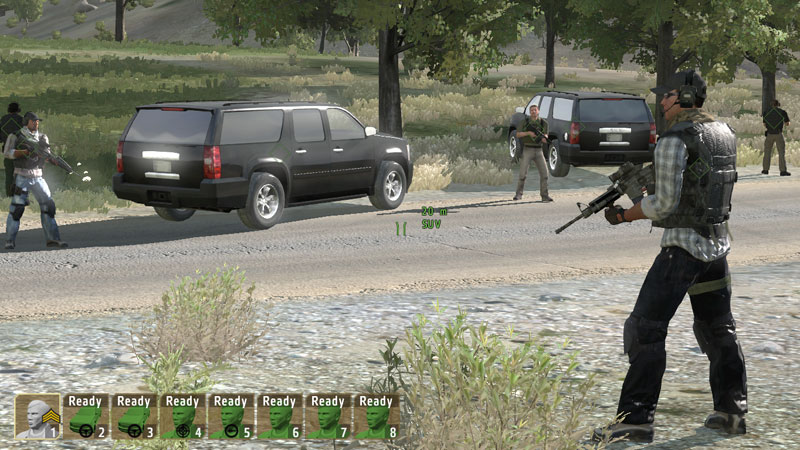
Right flank. Two of my men (right in the picture) watch towards the enemy controlled neighborhood.  Another of my men (left in the picture) overlooks our left flank.

A more detailed view of the contractor protecting our left flank. The open field in the background will force any enemy flanking units into a nasty kill box.
I position another man in the left flank. His position is almost in our rear.  He is the guy in our extreme left, and a few meters into our rear but I am going to be near him as I need to closely supervise the key weapon position nearby (see next picture).
Our key weapon (contractor #4) in a keyhole position. Beyond the arch in the wall, the street is getting hotter. 
The insurgents spot us and start coming down the street towards us.

Another view of our key weapon (contractor #4). He is kicking some serious butt (note the radio messages in green).
Here I am closely cooperating with my key weapon. Keyhole positions may produce some interesting fields of fire issues. In this picture, two insurgents can't be engaged by the key weapon (see insert in upper left corner), that's why I was there to provide support. The two insurgents were quickly neutralized by my  fire.

The firefight lasts for a good 4 minutes. The enemy tries to flank us at our left, but they get caught by the two contractors watching that flank. Our right flank doesn't get engaged.


Running from place to place within our defensive position (supervising and making sure everything is all right), I found this other excellent keyhole position in the house just in front of the mauled SUV. The street where the insurgents are coming from can be seen in the background. I would have loved to put my key weapon here, but it is difficult to herd AI-controlled team mates into houses.
When the firefight winds down, I bring a team member to over watch me while I retrieve the bodies.
Two casualties recovered. Time to bug out.
We mount up and get out of the place by going cross country, as far as we can from the built up area.

Cheers,

Friday, February 18, 2011

ArmA 2 Operation Arrowhead Private Military Company - Key Weapons in Keyhole Positions

Position key weapons in keyhole positions. Read that one in a US Marines Corps field manual and can't remember which one. Key weapons are usually automatic/heavy weapons and keyhole positions are ones with narrow and deep sectors of fire. A keyhole position is difficult to target simultaneously by a whole group of enemies. The enemy bounding group falls in the keyhole's field of fire and the over-watch group can't target the keyhole position.

This is a short story. It's not about US Marines and the key weapon is not a SAW but an XM8 kited with a longer barrel and two 100 rounds drums (the so-called automatic XM8). Not too different than the XM8 carbine I have in the role of  group coordinator.

Gah! Life at 5.56 mm! We are a 6 men group of contractors carrying XM8s, one FN FAL and one M4. With its 7.62 mm rounds, I would have preferred the FAL as the key weapon, but the rate of fire and ammo loadout of the automatic XM8 won the bet this time.

My group is the quick reaction force/counterattack team of a small convoy transporting a VIP through insurgent territory. One of the most famous convoy drills practiced by private security companies is to block intersections with one vehicle while the main body of the convoy zooms by. Today something went awfully wrong after a vehicle covering the intersection got fired upon by insurgents. The rest of the convoy didn't stop, and everybody expected the engaged vehicle to swiftly pull out of the kill zone. The convoy coordinator watched from the back of his speeding vehicle, horrified at the density of tracers zooming through the stationary vehicle left behind. Gator (our call sign), where the &#!@ are you!


We have our own problems. We trail a bit behind trying to keep gun tubes on a suspicious vehicle that follows us and doesn't neither approach us nor let us out of their sight. Before the radio call I had to fight the temptation to turn around and shoot the hell out of it. Our level of alert is high, but our security is lousily focused at those guys in our rear mirrors. Our driver is pretty much the only one doing his job right. He leans forward, as if trying to get t into focus the dim shapes of the firefight ahead. $#!+, did you see that?

Our SUV speeds forward towards the troubled vehicle. I pull the kevlar blanket from my door and throw it to the rear seats. Never let armor mask your fields of fire. We are about one kilometer, behind. We really messed up this one!

Panoramic view of the shoot out, or what is left of it. We (quick reaction force, to the right in the foreground) have arrived to the scene. A badly mauled SUV is in the intersection. There is one KIA contractor on the opposite side of the vehicle and another up the street. It looks like the contractor in the background was dragged and left there. The enemy fire has certainly come from the street that goes towards the background.
Stay tuned, more is coming soon.

Cheers,

Monday, February 7, 2011

ArmA 2 Operation Arrowhead British Armed Forces - Checkpoint Repels Insurgent Attack With .50 Cals

The game: ArmA 2 Operation Arrowhead British Armed Forces
The situation: a patrol section (+) manning an unfinished checkpoint is caught by surprise by insurgent forces.
The topic: in open terrain the .50 cal is king. Hone your HMG techniques of fire, lads!

The engineers came, built a half-assed checkpoint and left with the promise of finishing it up the following day. Checkpoint North was born out of wire, earthen parapets, small sandbagged bunkers and the willingness of the British soldier to do whatever it takes to accomplish a mission. Our command post/living quarters was a nice change, though. We have been sleeping near our Jackals for quite a while and having a roof over our heads was a welcomed change in the routine.

The entrance to checkpoint North.
Rush hour at checkpoint North. The line is a whooping 10 cars long.

The search area of checkpoint North. We didn't even have the proper search tools. 

Panoramic view of the checkpoint. In the distance, cars wait to enter towards the search area. The whole checkpoint is surrounded by a perimeter of concertina of approximately 500 meters. More visible in the image, the wire was also laid out at each side of the road.


On the right side of the road, we placed a Jackal in a firing position overlooking the main approach to the checkpoint. The command post/living quarters can be seen on the left.

Same thing on the left side of the road.
The reasons why we ended manning checkpoint North with so few assets are hard to justify. Our patrols platoon was conducting presence patrols in the area when the order to set up a checkpoint came in. Our CO decided not to interrupt such patrols because he got HUMINT about "something out of place with the insurgents cell phone traffic". We ended up at checkpoint North with just three Jackals (three teams or a reinforced section). A platoon should not be split when the enemy is in the bushes ... This is true since the time of the Boer Wars.

It was while following a HUMINT tip at a village south of the checkpoint when the distant sound of an IED and the ensuing frantic radio calls reached my 5 men team. We jumped in our Jackal and rushed towards the checkpoint trying to sort out what was going on.

The smoke and fire in the distant checkpoint ... Nothing good is coming out of this thing.
As we approached the chekcpoint, we could see the smoking trails of SPG-9 recoilless guns fired at the two Jackals that were already in position. There was only two vehicle fighting pits at the checkpoint and we needed a hull down position immediately. The Jackal is moderately tall, and hard to "hull down". Out of desperation I drove our vehicle behind the cover of the command post.

Hull down, but with an exposed gunner. Such is the life of the lightly armored vehicle crews.
The view from our vehicle. In the distance, insurgents pour out of an assortment of vehicles.

The AI does a moderately good job shooting the L111A1, but I eventually I had to man the thing. Note the sandbags of the roof of the command post.
Mayhem. In the crosshairs, a vehicle mounted SPG-9 I just engaged with the .50 cal. In real life, any soldier worth of his profession would have the ranges already figured out. He would even planted stakes to mark those ranges. In this scenario, I just fired in a Z pattern until I hit the bloody insurgents. The optics of the L111A1 really paid off.
We have been lucky. The insurgents approached over open terrain and our fields of fire were wide and deep. We lost two men and a Jackal to the enemy's SPG-9s. The checkpoint held without using a single AT weapon.

We eventually abandoned the relative safety of the checkpoint and moved up the road to clear it. In this image, the Jackal covers us with the .50 cal. 

Never underestimate the power of the .50 cal.

Cheers,

Monday, January 10, 2011

US Army Looking for Something Better than VBS2

The US Army is aiming to replace VBS2 by FY 2014. That is if they secure funds for it (given the future cuts in defense, who knows). Please see the full article at the Training and Simulation Journal.

“In our gaming strategy, we don’t want to be married to one application forever,” Parks said. “We want to utilize it as long as it’s relevant and it meets our training needs. But we know that technology and our training requirements change from year to year, and we want to remain relevant to our users.”


Cheers,


Saturday, January 8, 2011

ArmA 2 Operation Arrowhead Private Military Company - Breaking Contact (Firefight and Epilogue)

The farther, second bridge looks clear.


But that's the only piece of good news as we get abruptly interrupted by a truck approaching from the same route we took minutes ago.

A truckload of insurgents approaching towards the bridge. My men open fire immediately and we are now officially in contact.

This is not good, what a shame being caught with our pants down. There are too many of them. We need to disengage immediately. I throw a couple of smoke grenades to little effect.


I pull back in the direction of the canal bed, trying to disengage by bounds, with two of my men (team red) left covering #4 and me.


Those damn bushes again ... At #4's and my turn to provide over watch for team read I realize that is going to be very difficult to survive a firefight so outnumbered and with fields of fire so broken up.


My men look at me with incredulity ... I just pulled them into the canal. Your leader willingly putting you in a natural kill zone is not something to cheer about. But we are a small team and I am hoping that I can manage our fields of fire better than in those bushes up there.


Now the insurgents have covered flank approaches to our position. I direct team red to cover the terrain surrounding the bridge while #4 and me cover the flanks. It's a fiery firefight. The insurgents pop out from very close distance.


We take every short lull in the firefight to inch away from the bridge. After a series of cycles of shooting and pulling back, we are now away from the bridge and with a lot of insurgents dead.


It feels good to take our bellies out of the ground and move back to our car. We move cautiously, though as we don't know if the group of insurgents that attacked us is completely eliminated or if they have called for help.

One survivor of the insurgents team makes a run for the truck with the clear intention of escaping. We are at an ethical dilemma here since he is not shooting at us but he could alert some other group out there. Maybe he already did.


He must have been seriously injured, we think, as he wasted the truck in a nearby hill. We don't even bother to check it out up close.


We quickly move back to our car. It feels like an accomplishment. I am still shaky from the firefight we had minutes ago. We don't think it is safe to move through those damned bridges and we report to our coordinator promptly. Time to go back to the safe house.


Cheers,

ArmA 2 Operation Arrowhead Private Military Company - Breaking Contact

Contrary to popular imagination, we are not gun-toting cowboys. We have the our guns and we will use them. But we are never at war, just always in the crossfire ...

Our firm is trying to move the family of our client out of the war-torn countryside of Takistan. We have them in a safe house at a small town within the shrinking territories under control of the Takistani Army. We bribed the hell out of the Takistani officers and they will let this family go. They don't know whose family is this one and that's good because this is one of the traitors who brought to them the coalition invasion. Our money can buy us a very short span of time and we are conducting what in the private military contractor lingo is called  "short notice movement". Courtesy of the US Army, we are prohibited to use our helicopter. The excuse today is indirect fire deconfliction. How close the US Army is anyway?

Planning a route for moving a client through a war zone is an affair of intuition. They call it risk management but in the end is all second guessing after the motorcade is either safe or a bonfire outlasting an ambush. We barely had time to plan this one and I am afraid all the time of the world wouldn't have helped anyway. As the coalition forces push the Takistani Army towards the north, fanatical insurgents are claiming ownership of any inch square of terrain that is left in the path of withdrawal. Risk areas shift by the hour. All we could do is a map exercise assuming the worse: choose our movement routes, possible safe heavens for if it gets hairy, evacuation routes to those safe heavens and (what gives) helicopter landing zones for an extraction in case we feel extra brave to challenge the US Army's aerial curfew. Choke points, just one! , my boss told me with that annoying facial tick he pulls every time there is bad news.

They were technically two choke points, just very close to each other. A couple of bridges over two dried out canals channel all vehicular traffic coming out of the area we are trying to get out from.


My team of four men was assigned the security advance patrol (SAP) role. In areas as volatile as this one, SAPs are the eyes of the whole operation providing real time intelligence to the coordinator. We are to asses the trafficability of the bridges before the main body commits to this movement route. We traveled ninety minutes, delighted to cross paths with just the occasional small group of refugees. We are driving a civilian car, as much  inconspicuous as un-armored, to avoid bringing attention or bullets to us.


We can shoot the hell and more without dismounting from our SUVs. Even when their armor is good for just a couple of minutes of sustained hostile fire, we have always managed to transform "sustained hostile fire" into "scattered hostile fire" by using our firepower. We kind of developed muscle memory on how to shoot in any direction from them. This small blue sedan is a different story. Hell, we couldn't even figure out how to put up the extra kevlar blankets we brought along. We all agreed that our chances of speeding our way out from contact at the bridge would be very dim if we don't shoot back. Thus we decided to dismount and unveil any hostile position at the bridges not sitting on wheels but rather standing on our feet and holding our guns. We pull out of the road some kilometer before the bridges and leave our ride hidden between the rolling hills.


We keep our movement slow and on the left side of the road. There is plenty of bushes to conceal us and the rolling hills can be used to cover our withdrawal in case we get into contact.


Concealment is a two way avenue. The thick bushes get all my fields of view blocked as we approach the first bridge.


What a relief is to get to your target area and find it free of armed opposition.


Our motorcade operations can only thrive at high speeds. We ram the hell out of anything that denies us the edge of speed. Today it looks like somebody forgot to clean up this checkpoint before abandoning it. Ah, hell ... is it actually abandoned?


To be continued ...

Tuesday, December 14, 2010

Military Monday at SimHQ - ArmA 2 Operation Arrowhead

A great video by Brennus on the "Military Monday" online session with ArmA2 Operation Arrowhead.

Infantry supported by a Warrior IFV, clears a roadblock and moves onto a guerrilla campground.


"Military Monday" is an online session hosted by SimHQ. The players follow a chain of command and radio communications protocols. Realistic tactics are highly encouraged.

Original thread here. Make sure to view this video in YouTube for HD.

Cheers,

P/S: anybody here joins these sessions at SimHQ? Anybody plays ArmA 2 online at a virtual unit?

Cheers,

ArmA 2 Operation Arrowhead PMC - Why I am still interested

[...] private military forces offer a level of flexibility and promise of efficiency when coping with threats to global market function. An example of this was see most recently in the havoc created by Hurricane Katrina in New Orleans. When the federal government, because of bad management and legal barriers using federal forces, failed to act, PMCs stepped into some of the breaches. Companies such as Blackwater and others quickly sent forces to New Orleans to protect high-value for corporate clients (from looters) and provided extraction details for high-net-worth individuals and valuable corporate employees.
From Brave New War: The Next Stage of Terrorism and the End of Globalization
By John Robb


ArmA 2 is an entertainment product, yet oriented towards a niche of the gaming market. It is a simulation of infantry tactical warfare realistic enough that an off-shot of the original game engine is used for training in military forces around the globe. Popularity and media buzz-wise, the Private Military Comapny (PMC) DLC is not the hottest Bohemia Interactive module. When I got it myself I thought -Meh! What will be next ...a  Red Cross refugee-relief module?

There is an entire school of thought that is raising the flag about sovereign states no longer having the monopoly in the delivery of violence against masses of people. Violence at a scale that can tip the political stability of a whole state. John Robb is in the cutting edge of this idea that was originally put forward by Martin van Creveld. Global terrorism and the Mexican drug cartels are two examples of the new actors in this whole new game the world is witnessing. The idea of a state without the resources (legal or material) to cope with non-state threats to its existence is scary. But even more scary is the idea that anybody with enough money can pay to enter the game. And I am not talking about the "10 dollar Taliban" that can't hit a cow in a corridor with his cousin's 20-year-old assault rifle. I am talking about ex-special operations veterans armed with modern weaponry that can bring down a building in their sleep. Enter the private military contractor ...

Although the political, strategic and operational minutia of the fictional war in Takistan are out of reach for the ArmA2 OA PMC player, the tactical grind of the simulation offers a rare opportunity to experience the life of the military contractor. And I say rare not because this is the first "mercenary" shooter in the market but because is the only one that we can hope will deliver the goods in a way more close to reality. Under-manned,  under-gunned, no indirect fire support, tactical mobility not a lot better than your wife's during a trip to the mall, with a huge baggage bogging down the tactical tempo (do we really need to protect these clients? ;) ), the challenge will be there. Unfortunately, the canned missions of the PMC DLC are not that appealing. At least for me, ArmA was never at story-telling and I was not actually hoping anything stellar with this module. But the sandbox is open for mission creators!

And now if you excuse me, I have to finish my read of the FRAGO contract and send my SITREP invoice to my commander client. :)

Cheers,

Tuesday, September 28, 2010

ArmA 2 Operation Arrowhead British Armed Forces - On Being Section and Fireteam Leader at the Same Time - Part 1

The British Army's small-units tactical doctrine is secret. No field manual for you, civilian! There are a few books out there from which you can make up some pieces of the puzzle. But ... oh boy ... these accounts show you only shadows.

I will be out on a limb with these series of posts about the use of British Sections in ArmA 2. So take them with a big grain shovel of salt. Non-educated guesses coming.

The composition of a generic British rifle section is one of the few things we know for sure :
  • Section Commander
  • Rifleman
  • Grenadier
  • Automatic Rifleman
  • Fireteam Leader Section's 2nd in Command (2IC)
  • Rifleman
  • Grenadier
  • Automatic Rifleman
This section has two fireteams (labelled red and blue above) that are quite symmetrical in terms of firepower. Symmetry we can cope with (we have already been fighting with symmetrical US Army and Marines squads), but as you may have realized the British section commander has to keep an eye on his fireteam (red) and the whole section at the same time. The ratio between section and fireteam commanders (movers) over the amount of fireteams (moving parts) is 2/2=1 in the British infantry section. The same ratio is 3/2=1.5 in an US Army infantry squad and 4/3=1.33 in the US Marines rifle squad. 

Short in men and decision-makers, it looks like as if the British infantry section is conceived as a tactical entity that never operates independently from its parent platoon. If this is true, I wonder how challenging is to go into combat with a British section in the ever fragmented battlefields of today where every section or squad mostly fight different fights.

In ArmA2, the British rifle section is composed of (each soldier picture has a short description of his weapon too):

1st Fireteam


2nd Fireteam


Nice surprise in ArmA 2 is to have the so-called "marksman" with the L86A2 light support weapon. This awesome piece of hardware was originally conceived as a support weapon, but since it has a relatively high range (can deliver accurate fire up to 600 meters or so) it is used almost like a sniper role. Almost, because the caliber of the L86A2 is the same as the L86A2.

In the next installment, I will get into a fight along with these men.

Cheers,